A two-stream AI architecture that fuses present-day geophysical signatures with reconstructed deep-time geodynamic trajectories — delivering exploration-ranked prospectivity maps that outperform conventional spatial models by 40% on the metrics that matter most to drillers.
Spatiotemporal porphyry copper prospectivity animated from 170 Ma to present day. Colour intensity reflects predicted probability of deposit formation at each time slice. Known deposits and their metric tonnage are overlaid.
+40%Recall@5% vs spatial-only
0.95AUC-ROC score
170 MaTemporal history
72%Known deposits in top 5% area
Problem
Conventional prospectivity misses the temporal dimension
Porphyry copper systems — the world's largest copper and molybdenum ore bodies — form under highly specific geodynamic conditions that are transient in geological time. A location may have been tectonically fertile at 50 Ma and entirely barren today, or vice versa. Standard spatial prospectivity models, which rank areas based solely on present-day geological and geophysical attributes, are blind to this temporal complexity.
The result: large swaths of historically productive arc terranes score poorly on spatial models because their surface expression has been obliterated by erosion, while genuinely prospective areas at depth go unranked. The exploration industry loses capital chasing poor targets and under-invests in the right ones.
"The question is not where the rocks are — it is when the system was fertile. That question cannot be answered without reconstructing Earth's past."
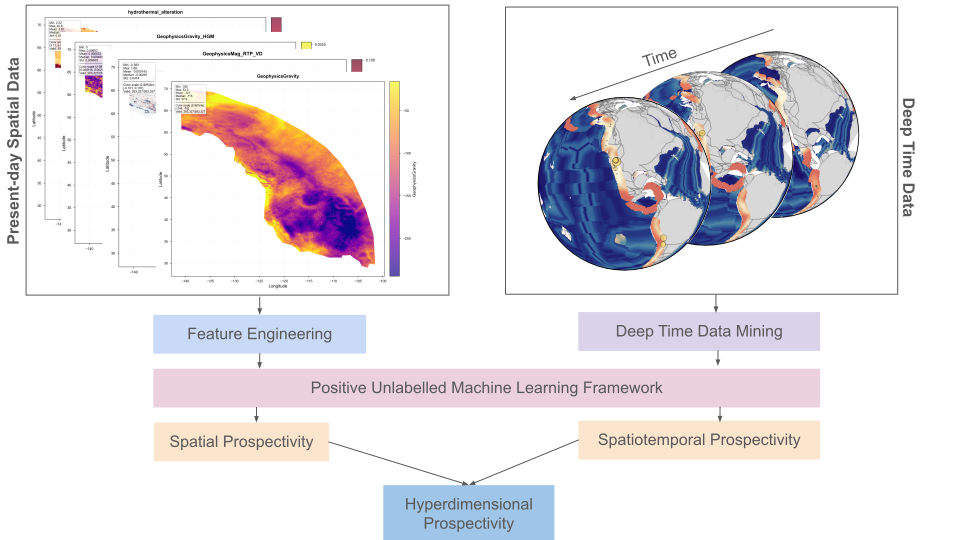
Figure 1 — Conceptual workflow: the hyperdimensional framework integrates 2D present-day spatial data with 4D deep-time geodynamic parameters via a Positive-Unlabeled XGBoost pipeline, producing a prospectivity surface that answers both WHERE and WHEN.
💡
The subducted carbonate flux — the mass of carbonate-rich sediments dragged into the mantle at convergent margins — is one of the strongest predictors of giant porphyry formation. It cannot be observed in present-day data; it must be reconstructed.
Geonome's hyperdimensional prospectivity engine runs two independent machine learning pipelines — a spatial stream trained on present-day observables and a temporal stream trained on reconstructed geodynamic trajectories — then fuses their outputs multiplicatively to generate a single, exploration-ranked score.
Stream A — Spatial Prospectivity
01
Present-day geophysical inputs: Bouguer gravity, magnetic intensity, radiometric K-Th-U, SRTM elevation, crustal thickness, regional alteration indices, and lithological proximity features from publicly available continental datasets.
02
Geology-aware feature engineering: Raw pixel values are transformed into regional context vectors — 50 km neighbourhood statistics, structural gradients, and textural heterogeneity indices. Deposits are controlled by mesoscale processes, not single-point values.
03
Positive–Unlabeled (PU) Bagging: Because unknown areas are not confirmed absences, standard binary classification would introduce systematic false negatives. PU Bagging treats unlabelled pixels as uncertain, trains multiple classifiers on random subsets, and aggregates to a probabilistic permissivity score.
Stream B — Deep-Time Geodynamics
01
4D Earth reconstruction: Using Geonome's pyDTDM library and GPlates plate kinematic models, each target location is tracked through geological time. For every time slice (5 Ma intervals, back to 400 Ma), we compute: convergence rate, obliquity, subducted carbonate volume, slab dip, crustal thickness, and arc-trench distance.
02
Temporal trajectory features: Each location is represented as a time series of geodynamic variables. Peak values, integrated fluxes, and rates-of-change encode the fertility window — the period when conditions were most favourable for porphyry formation.
03
Same ML framework, richer data: The temporal stream uses identical PU Bagging + XGBoost architecture as Stream A, trained on temporal features rather than spatial. The model learns: "Did this location ever experience the right conditions?"
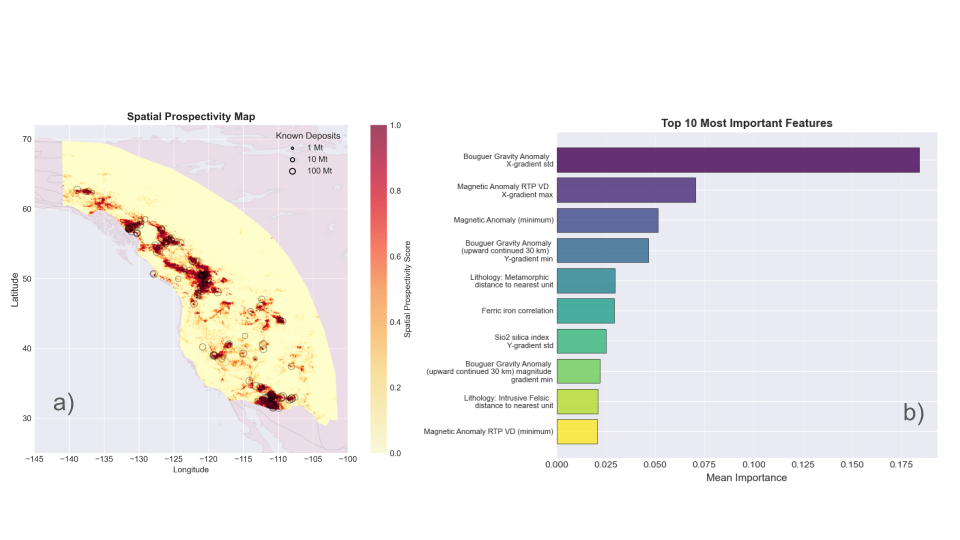
Figure 3 — Spatial prospectivity modelling output. (a) Spatial prospectivity map from present-day geophysical, geological, and geochemical predictors — warmer colours indicate higher prospectivity, circles denote known copper deposits scaled by size. (b) Feature importance analysis revealing dominant spatial predictors: Bouguer gravity gradients, magnetic anomalies, and lithological proximity.
AI Architecture
Hyperdimensional integration — the AND gate for mineral discovery
The final prospectivity score is the product of both streams: H(x,y) = S(x,y) × T(x,y). Multiplication enforces a conjunctive condition — a location scores high only when both the present-day geophysical setting is permissive AND the deep-time geodynamic history was fertile. This mirrors geological reality: no amount of favourable present-day structure compensates for a tectonically barren history.
⚡
The carbonate–redox engine: Subducted carbonates increase the oxygen fugacity (fO₂) of arc magmas, destabilising sulfide phases and mobilising copper into the melt. Crustal thickness amplifies this effect by prolonging magma residence time. The temporal model learns this mechanism without being told — it emerges from the data.
XGBoost was selected over deep learning alternatives for two reasons specific to exploration: (1) its feature importance scores directly map to geological variables, enabling geoscientific validation; and (2) it performs robustly on small, imbalanced training sets — the norm in undiscovered deposit databases.
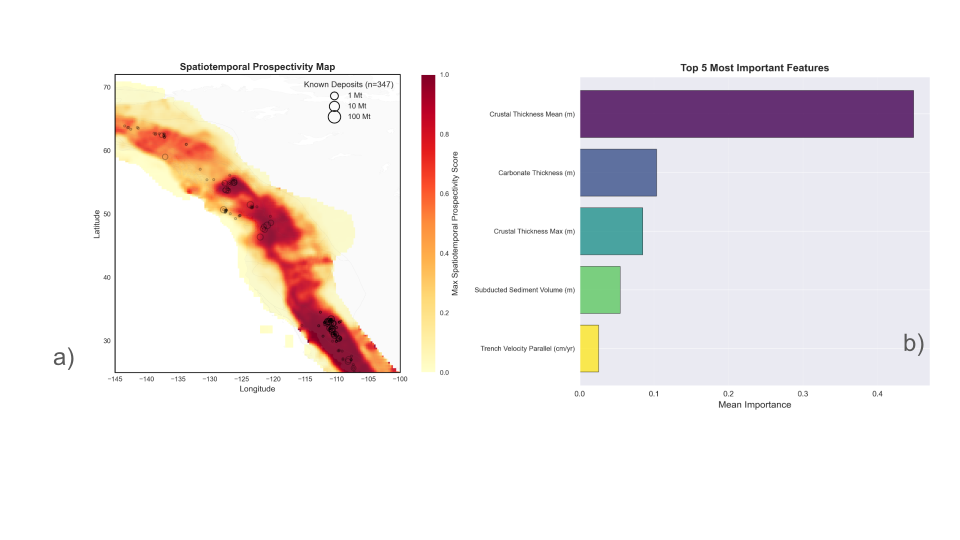
Figure 4 (a–b) — (a) Maximum spatiotemporal prospectivity map integrating deep-time reconstructions with known deposits overlaid. (b) Deep-time feature importance: crustal thickness is the dominant predictor, followed by subducted carbonate flux — the AI has independently rediscovered the carbonate–redox engine.
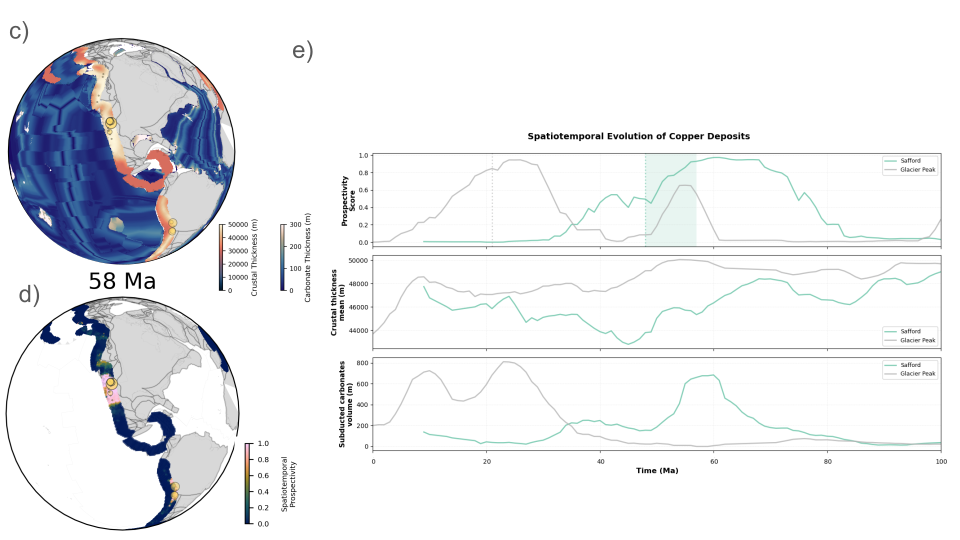
Figure 4 (c–e) — Deep-time tectonic reconstructions and temporal model behaviour.
(c–d) Plate-tectonic reconstructions at ~58 Ma — the formation window of the Safford porphyry copper deposit — showing the subduction configuration alongside the spatial distribution of overriding-plate crustal thickness, subducted carbonate thickness, and the resulting spatiotemporal prospectivity.
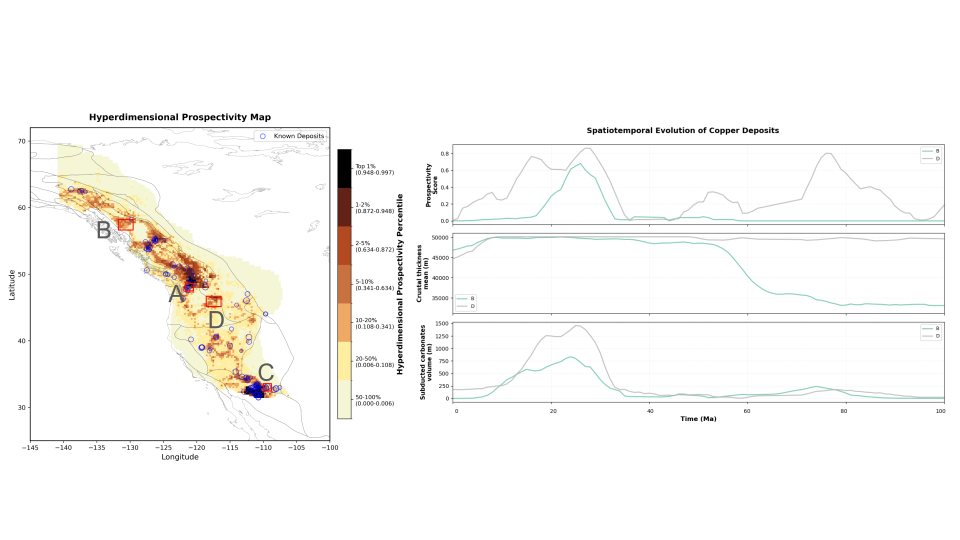
(e) Temporal evolution of predicted prospectivity and key deep-time predictors (crustal thickness, subducted carbonate flux, plate convergence rate) for the Safford and Glacier Peak deposits — demonstrating how transient pulses in subduction dynamics drive the timing of porphyry copper formation, and how the AI captures these windows directly from the geodynamic record.
Why It Matters
A fundamental shift in how exploration capital is deployed
The exploration industry has a capital efficiency problem. Industry-wide discovery rates have declined for two decades despite growing investment, partly because conventional prospectivity tools — geological maps, geochemical anomalies, geophysical surveys — are all snapshots of the present. They tell you where geology is permissive today; they cannot tell you whether it was fertile when the mineralising event occurred.
Geonome's hyperdimensional model reframes the core question: rather than "where are the rocks?", the model asks "when and where did the system become capable of forming a giant deposit?" This shift recovers targets that spatial-only approaches systematically miss — particularly in deeply eroded or overprinted terranes where surface expression is ambiguous.
📊
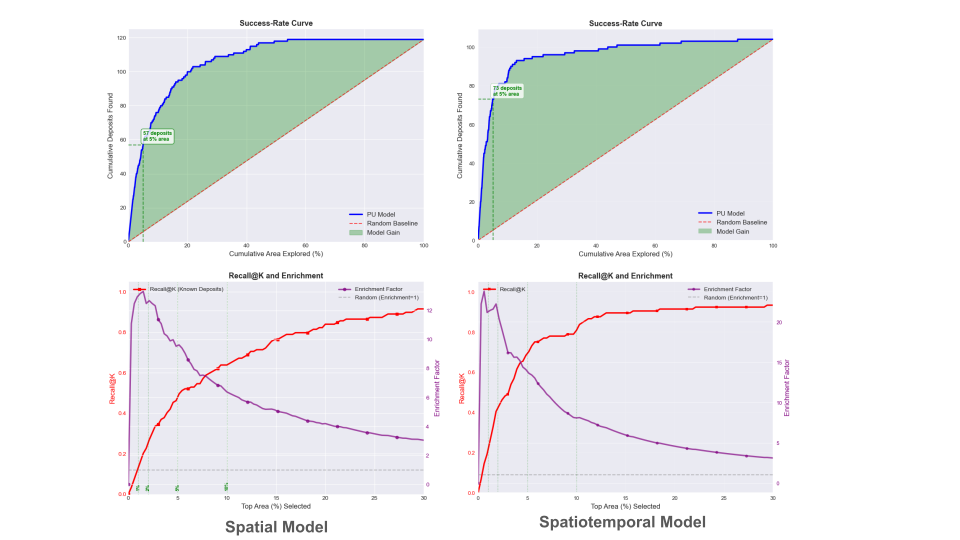
Exploration efficiency benchmarks: On a global porphyry copper test set, the hyperdimensional model recovers 72% of known deposits within the top 5% of predicted area — versus 51% for a spatial-only baseline. At the top 10% area threshold, Recall reaches 89%. Every 1% of area explored under the hyperdimensional ranking contains 3.2× more deposits than random selection.
Figure 2 — Model evaluation using success-rate curves and recall–enrichment metrics. The spatiotemporal model captures a substantially larger proportion of known deposits within a smaller exploration footprint — the gap between curves is directly recoverable exploration capital.
Industry Impact
Production-ready targets across three major arc systems
The hyperdimensional model has been validated across Tethyan (Southeast Asia, Middle East), Pacific Rim (Andes, Alaska, British Columbia), and Andean arc systems, demonstrating generalisability beyond the training region. High-confidence target clusters in each belt are characterised by consistent co-elevation of both spatial and temporal scores — the signature of genuine geological fertility rather than model artefact.
3Major arc systems validated
14×Enrichment factor (top 5%)
89%Recall@10% area
3.2×Deposit density vs random
Figure 5 — Hyperdimensional prospectivity map: present-day spatial datasets combined with deep-time tectonic predictors, shown as percentile values. Known porphyry deposits are overlaid. (A, C) Giant deposits Glacier Peak (1,710 Mt) and Safford (7,260 Mt). (B, D) High-score locations in previously underexplored regions exhibiting tectonic conditions comparable to major porphyry systems — indicating high discovery potential.
Technology Stack
The engine behind deep-time discovery intelligence
Every component of the Geonome deep-time prospectivity stack is purpose-built for geoscience: open-source at the data layer, proprietary at the modelling layer, and fully auditable throughout.
pyDTDM — Geonome's open-source Python library — automates the extraction of geodynamic time series for arbitrary geographic locations. It interfaces directly with GPlates plate motion models to reconstruct subduction history, convergence geometry, and sediment flux for any point on Earth, at any time in the past 400 Ma.
Model outputs are delivered as georeferenced probability rasters in GeoJSON and GeoTIFF formats, compatible with ArcGIS, QGIS, and Leapfrog. SHAP value maps are included with every deliverable, showing the geodynamic drivers behind each target score — so your geological team can validate every recommendation against first-principles geology.
Go deeper — full technical masterclass
End-to-end walkthrough of the AI methodology: PU learning theory, feature engineering for deep-time variables, the carbonate–redox engine, hyperdimensional fusion mathematics, and interpretation of SHAP-ranked outputs.
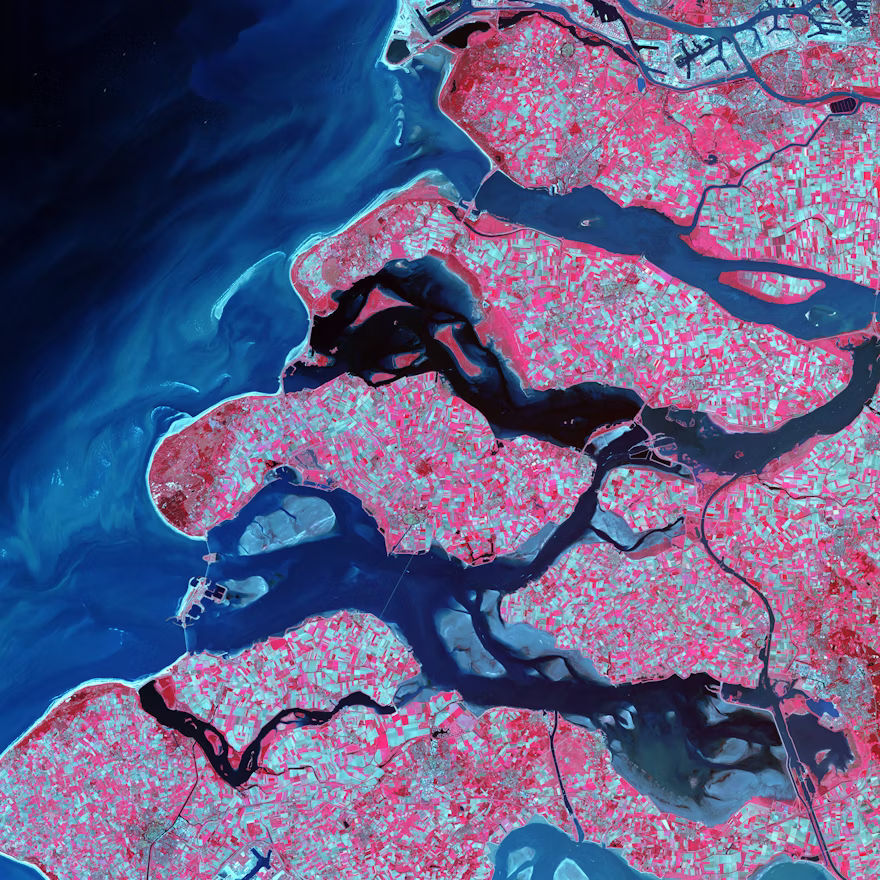
Multi-sensor spectral AI discriminates ultramafic lithologies at 15 m resolution without field access — enabling rapid, high-confidence geological classification across 4,800 km² of high-altitude terrain.
End-to-end AI methodology — PU learning theory, deep-time feature engineering, the carbonate–redox engine, hyperdimensional fusion, and SHAP-ranked output interpretation.
Your details are stored securely and never shared. Geonome Privacy Policy applies.