02
Hyperdimensional Porphyry Copper Prospectivity
Two-stream AI architecture fusing present-day geophysics with reconstructed deep-time geodynamic trajectories. +40% Recall@5% over spatial-only models.
Autonomous discrimination of ultramafic lithologies across inaccessible high-altitude ophiolite terrain using multi-sensor spectral intelligence — delivering geological maps at resolution and speed no field team can match.
Problem
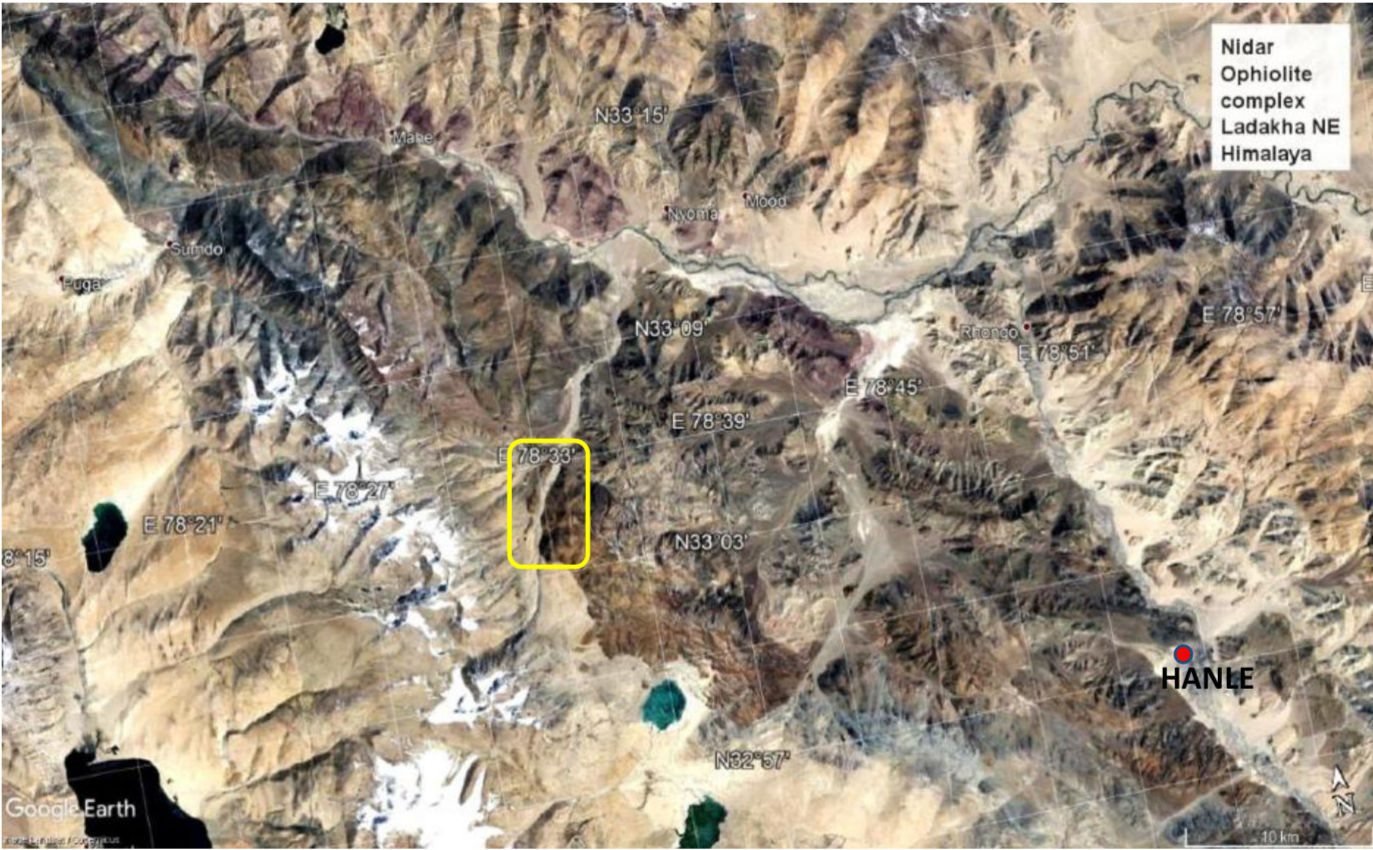
Ophiolite complexes — slices of ancient oceanic crust and upper mantle obducted onto continental margins — host critical mineral systems including chromite, nickel, and platinum-group elements. The Nidar Ophiolite in Ladakh, NW Himalaya, sits at elevations exceeding 4,500 m, making conventional traverse mapping costly, slow, and weather-constrained.
Traditional ground surveys require weeks per campaign and produce sparse point data. Aerial photogrammetry captures morphology but lacks mineralogical discrimination. The exploration industry needed a method that could rapidly and reliably classify lithologies — dunite, peridotite, gabbro, and their serpentinised variants — at regional scale from orbit.
"The question was not whether satellites could see these rocks — it was whether AI could learn to read them the way a field geologist would."
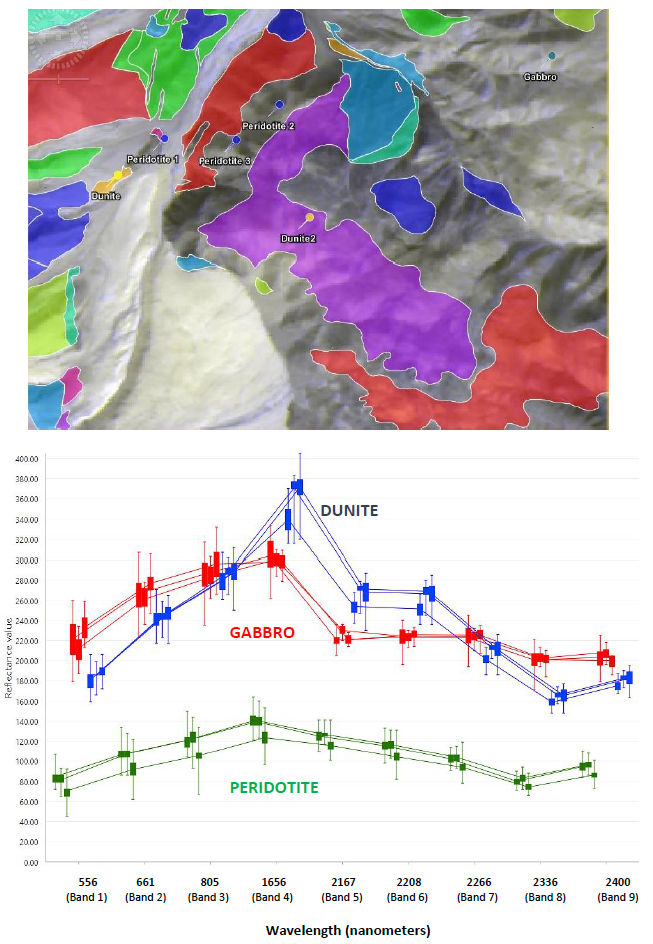
Ophiolite lithologies carry distinct spectral signatures driven by iron-oxide states (Fe²⁺/Fe³⁺) and hydroxyl-bearing alteration minerals (Mg-OH, OH at 2200–2300 nm) — precisely the absorption features captured by modern multispectral and hyperspectral sensors.
Approach
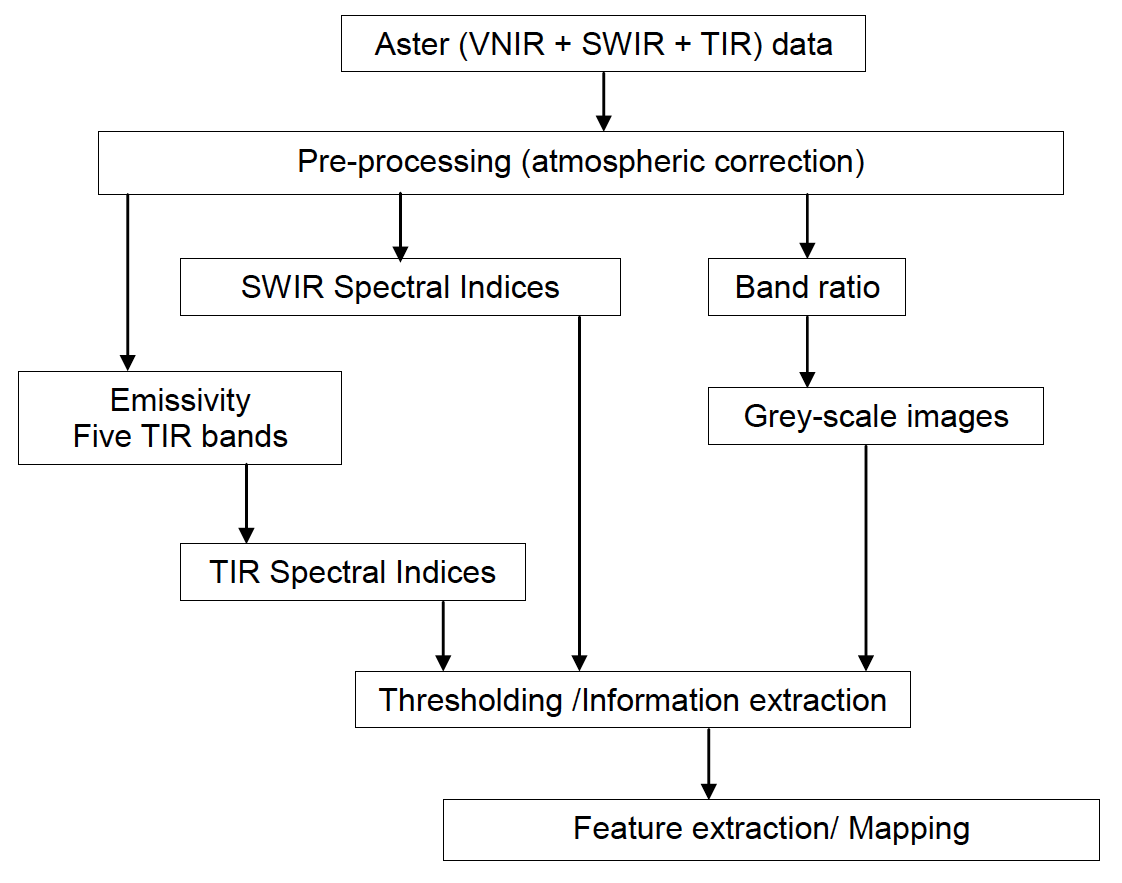
Geonome's geological mapping workflow layers three complementary satellite datasets through a physics-informed preprocessing and classification engine. Each sensor contributes unique spectral dimensionality that, when fused, enables lithological discrimination impossible with any single platform.
AI Architecture
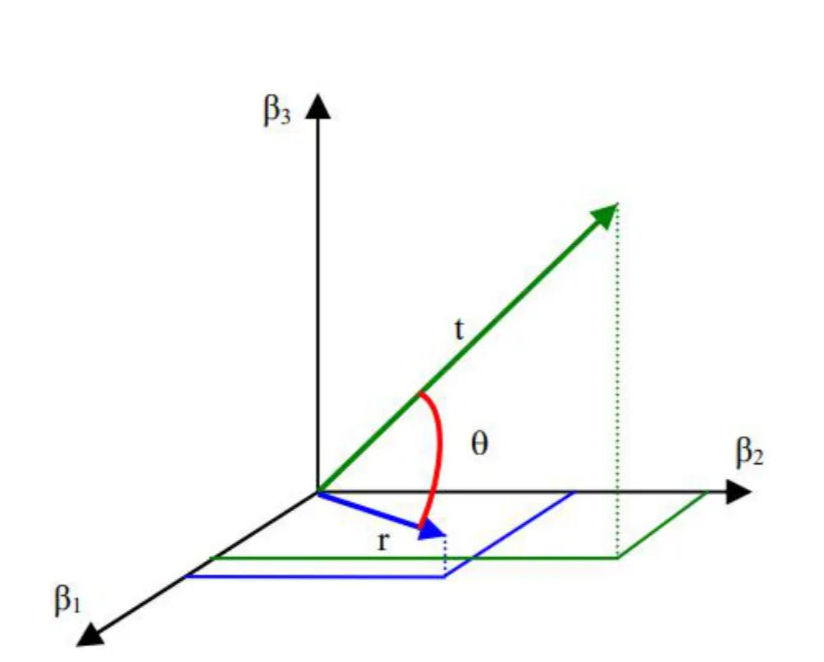
The core classification engine uses Spectral Angle Mapper geometry as a physics-grounded similarity measure — every pixel is assigned to the class whose reference spectrum it most closely matches in N-dimensional spectral space, independent of brightness variations caused by topography or illumination angle.
For ambiguous lithological boundaries, an XGBoost ensemble trained on geology-aware feature vectors adds a second classification pass. Features include contextual neighbourhood statistics (texture, gradient, local variance) that encode mesoscale structural information — because contacts between dunite and peridotite are rarely sharp at the pixel scale.
Key differentiator: All classification decisions are traceable to specific spectral absorption features, making every output verifiable by a domain geologist — not a black box.
Industry Impact
The final classification map delivers six lithological units at 15 m spatial resolution — dunite, harzburgite, lherzolite, serpentinite, gabbro, and undifferentiated volcanics — georeferenced and validated against existing 1:50,000 geological survey sheets.
Chromite-bearing dunite zones are spatially correlated with gravity and structural anomalies to generate ranked exploration targets. The entire analytical cycle — from satellite tasking to validated target list — runs in under 72 hours. A comparable field mapping programme would take 6–8 weeks, at five times the cost.
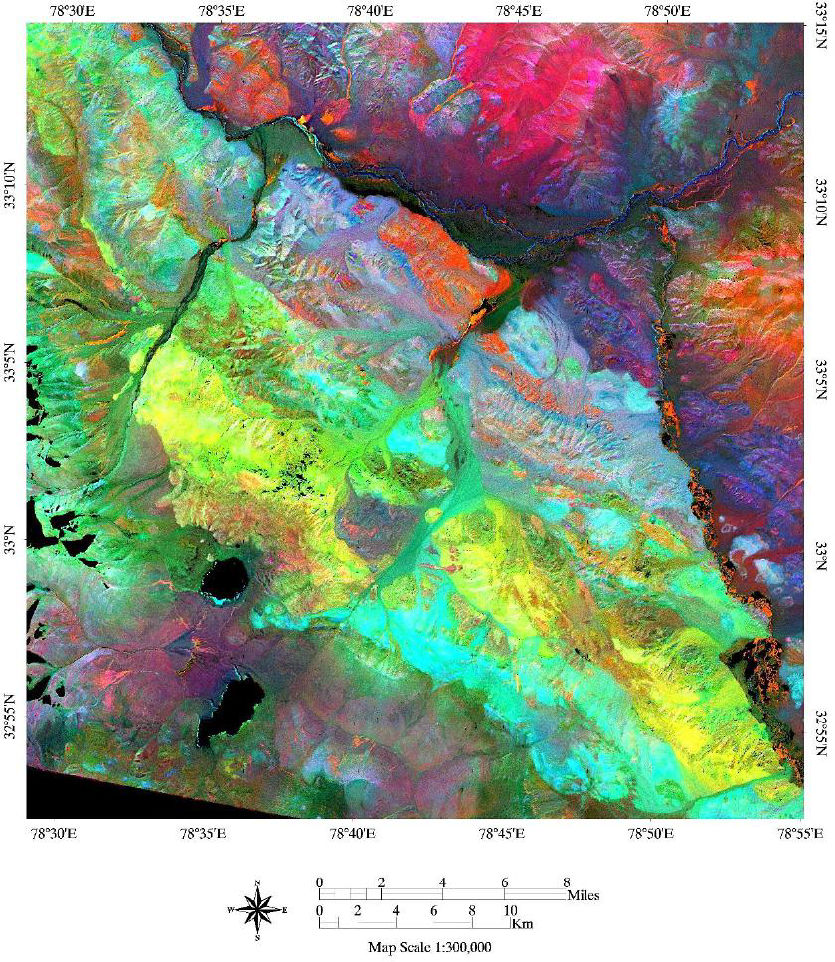
The spatial correlation between AI-mapped serpentinisation halos and known chromite occurrences achieved a 91% Recall@K at the top 10% of flagged areas — meaning nine out of ten known deposits fell within the top-decile risk zone identified entirely from satellite data.
Technology Stack
Geonome's satellite mapping stack is built on open-standard data pipelines, physics-grounded preprocessing, and field-validated classification algorithms — with every analysis step logged for full auditability.
Sensor selection rationale: Sentinel-2 delivers 10 m structural context; ASTER adds mineralogical specificity via SWIR Mg-OH bands unavailable on Sentinel; Hyperion provides the continuous spectral library that anchors all classifications to physical absorption features rather than empirical correlations.
Processing runs within Geonome's Kalpa platform — a unified geospatial AI environment that manages data ingestion, preprocessing, model inference, and output delivery in a single auditable pipeline. Satellite access is handled through Vyom, our Python-native Earth observation API.
Step-by-step tutorial covering the complete methodology: spectral physics, sensor selection, preprocessing, classification algorithms, and interpretation — built for both geoscientists and data scientists.
Two-stream AI architecture fusing present-day geophysics with reconstructed deep-time geodynamic trajectories. +40% Recall@5% over spatial-only models.
Ready to apply these capabilities to your exploration programme?
Get in Touch