Spatial AI → Deep-Time AI → Hyperdimensional Fusion
AI-Driven Mineral Prospectivity:
From Present-Day Maps to 4D Earth Modelling
Where in the world should you drill for porphyry copper? Traditional geology gives you a map and a set of favourable rock types. But the real question is harder: not just where the crust is permissive, but when the tectonic system became fertile. This tutorial teaches you how to build an AI that thinks in four dimensions — space, time, geodynamics, and geochemistry — to find the next generation of giant copper deposits.
By the end of this tutorial you will be able to:
- Explain why porphyry copper deposits require both spatial permissivity and temporal tectonic fertility to form.
- Design geology-aware feature engineering that encodes regional context, not raw pixel values.
- Explain Positive-Unlabeled learning and why standard classification fails for mineral prospectivity.
- Interpret AUC-ROC, AUC-PR, Recall@K, Enrichment Factor, and Success-Rate Curves in exploration terms.
- Reconstruct deposit trajectories through geological time and extract deep-time geodynamic predictors.
- Explain the carbonate–redox engine: how subducted oxidised carbon unlocks copper from the lower crust.
- Build and interpret a hyperdimensional prospectivity model using multiplicative spatial × temporal fusion.
- Understand why adding deep-time history improves Recall@5% from 48% to 70% — a step-change in exploration efficiency.
Spatiotemporal porphyry copper prospectivity evolving from 170 Ma to the present day across the North American Cordillera. Colour intensity reflects predicted probability of deposit formation at each geological time slice. Known deposits are overlaid scaled by metric tonnage — watch how the model assigns high probability to deposit locations during their actual mineralisation windows before fading as tectonic conditions shift.
The Problem: Finding Porphyry Copper from Space
Before any machine learning, we need a sharply defined problem. Mineral prospectivity mapping asks a deceptively simple question: given everything we know about the Earth's surface and near-surface geology, where is a porphyry copper deposit most likely to be hiding?
What is a Porphyry Copper Deposit?
Porphyry copper deposits are the world's largest copper ore systems — single deposits can contain billions of tonnes of copper, molybdenum, and gold. They form when magma rising through the crust releases enormous volumes of hot, metal-charged hydrothermal fluid that alter and mineralise a large cylindrical rock volume. The iconic examples — Chuquicamata, Escondida, Bingham Canyon — supply a substantial fraction of global copper production.
Their formation requires a very specific chain of conditions: the right magma composition, the right crustal thickness to allow differentiation, the right structural plumbing for fluid focusing, and the right tectonic context to produce oxidised, volatile-rich magmas. This chain is rare. Most subduction systems never produce a giant porphyry. Understanding what makes the rare ones different is both a scientific problem and an economic imperative — copper is critical for the energy transition, and known deposits are being depleted.
The Mapping Problem in Precise Terms
We have a continental-scale grid of cells — say, 5 km × 5 km resolution across the North American Cordillera. For each cell, we have a suite of geophysical measurements (gravity, magnetics), lithological context (rock type distances, alteration indices), and geochemical indicators. A subset of cells contains known porphyry copper deposits. The rest are unknown.
The task is to assign each cell a prospectivity score between 0 and 1 — a probability-like ranking of how likely that cell is to host an undiscovered deposit. This score is then used to prioritise exploration: spend drill budget in high-score areas first.
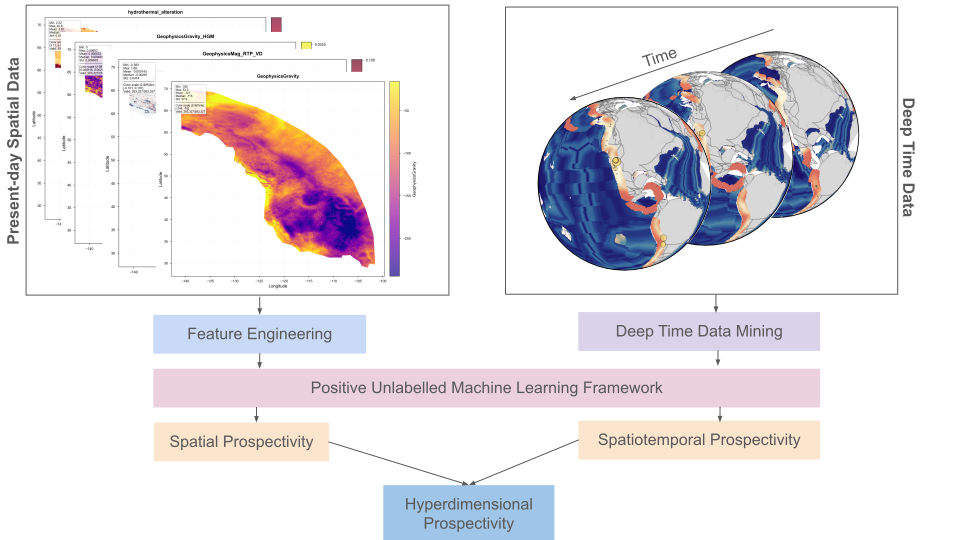
Figure 1 — Conceptual and methodological workflow for hyperdimensional prospectivity mapping. The framework integrates 2D present-day spatial data (hydrothermal alteration, Bouguer gravity, magnetic anomaly) with 4D deep-time geodynamic parameters (plate kinematics, crustal thickness) via a Positive-Unlabeled XGBoost framework. The final hyperdimensional prospectivity is the multiplicative product of the spatial prediction and the maximum temporal favourability at each coordinate.
The Concept of Spatial Permissivity
Not every location can host a porphyry copper deposit. The crust must be structurally permissive: there need to be magmatic pathways, fault corridors for fluid channelling, and evidence of the right igneous and hydrothermal history. Spatial permissivity is the question asked by the spatial model: "Does the present-day geological architecture of this location make it a plausible host?"
Key spatial indicators include:
Geophysics
Gravity and magnetic fields encode density and susceptibility contrasts — revealing buried intrusions, fault zones, and crustal architecture invisible at surface.
Alteration Indices
Hydrothermal alteration — potassic, phyllic, propylitic zones — is the chemical fingerprint of past ore-forming fluids. Remote sensing indices detect alteration minerals from orbit.
Lithology Proximity
Proximity to porphyritic intrusives, metamorphic basement, and structural corridors (faults, shear zones) that channelled ore fluids during mineralisation.
Structural Gradients
Spatial derivatives of geophysical fields reveal structural boundaries — the edges of buried intrusions, terrane boundaries, and deep crustal sutures that focused magmatism.
Key Insight
The spatial model answers: "Does this location look like the geology around known deposits?" It is a powerful pattern-recognition exercise, but it is fundamentally limited to the present snapshot. It cannot tell you whether favourable conditions actually existed in the past — and that limitation, as we will see in Part 2, matters enormously.
Why This is an AI Problem
If finding porphyry copper deposits were just a matter of overlaying a few geological maps, exploration geologists would have done it already. The challenge is fundamentally one of complexity — and that is precisely why machine learning is the right tool.
Three Reasons Physics Alone Fails Here
Nonlinear, high-order interactions
Porphyry formation is not controlled by any single factor. It requires a conjunction: high crustal thickness and specific structural architecture and the right magma composition. These conditions interact nonlinearly — a small change in one can make the others irrelevant or decisive. No simple linear equation can capture this.
Hundreds of interacting variables
After feature engineering, the spatial model uses hundreds of input features — gravity gradients, magnetic field statistics, texture descriptors, distance metrics — each varying continuously across the continent. The human brain cannot synthesise these into a consistent ranking across millions of grid cells. An ensemble ML model does this naturally.
No complete physical model
We do not have a deterministic equation that maps from "gravity field value, magnetic anomaly, distance to nearest intrusive" to "deposit exists here." The physics is too complex, too coupled, and too poorly constrained at the relevant scales. But we do have examples of what success looks like — known deposits. Machine learning learns the pattern from those examples.
Key Insight: From Rules to Learning
Traditional prospectivity mapping used expert-defined rules ("score this factor, weight it, add the scores"). Machine learning replaces this with a data-driven objective: find the function that best separates known deposits from background, given all available predictors simultaneously. The result is a model that discovers relationships geologists may have missed — and quantifies their relative importance.
Feature Engineering: Teaching Geology to the Machine
The single most important decision in this workflow is not which ML algorithm to use. It is how to represent the input data. Raw pixel values from a gravity map tell the model almost nothing useful. Geology-aware features — derived with domain knowledge — tell it everything.
Why Not Raw Pixel Values?
Imagine you are a geologist standing at a grid cell and someone asks: "Is this a good location for a porphyry copper deposit?" You would not just look straight down. You would look around — at the regional structural setting, at whether you are near a major crustal boundary, at how heterogeneous the geophysical field is over the next 50–100 km. You are thinking in context.
A raw pixel value tells the model: "At this exact point, the gravity value is X." A geology-aware feature tells it: "Within 50 km of this point, the gravity gradient shows a sharp boundary, the magnetic field is highly heterogeneous, and the mean value is consistent with thickened crust." That is the information that controls deposit formation.
Figure 3.1 — Geology-aware feature engineering: for each target grid cell, statistical and structural features are extracted from a 50 km neighborhood window. This transforms a single raw value into a rich contextual description that encodes the regional geological setting.
Four Feature Families and Their Physical Meaning
Key Insight: Context Controls Deposits
A gravity value of −50 mGal at a single point is almost meaningless. The same value, when surrounded by a sharp gradient boundary to the east, high magnetic heterogeneity within 50 km, and proximity to mapped metamorphic basement — that combination is highly diagnostic. Feature engineering is the act of encoding geological reasoning into the model's input vocabulary.
Common Mistake
Applying PCA or similar transforms to compress raw features into latent components before ML training. This destroys geological interpretability — you lose the ability to say "the model is responding to gravity gradients (structural control)." Instead, use geology-aware feature selection: remove near-zero variance features and high-correlation duplicates, but preserve the physical groupings (structural, fertility, texture, proximity).
Positive–Unlabeled Learning: The Most Important ML Decision
Before we even choose an ML algorithm, we must confront a fundamental problem with mineral exploration data. This problem is so important that getting it wrong invalidates the entire model — yet it is often overlooked.
The Label Problem in Mineral Exploration
In a standard binary classification problem, you have two classes: positives (deposits) and negatives (not deposits). The model learns the difference and predicts which class new cells belong to.
The problem: we have no true negatives in mineral exploration. We know where deposits have been found. We know nothing about where deposits do not exist. An unexplored cell in the Yukon wilderness is not a confirmed absence of copper — it is simply an undrilled cell. It could be the next Escondida.
If we naively treat all non-deposit cells as negatives and train a standard classifier, we are telling the model "here are 274 positive examples, and here are 500,000 confirmed negatives." But those 500,000 "negatives" include an unknown number of undiscovered deposits — false negatives injected directly into training. The model learns to avoid exactly the patterns it should be finding.
Figure 4.1 — The fundamental difference between standard binary classification and Positive-Unlabeled (PU) learning in mineral prospectivity. Unknown background cells may contain undiscovered deposits. PU learning treats them as "unlabeled" rather than confirmed negatives, preventing systematic bias in the learned model.
PU Bagging: The Solution
PU Bagging is an elegant ensemble strategy that handles the label incompleteness problem through deliberate, structured sampling. Here is exactly how it works:
All verified known deposits are the positive class. All remaining grid cells — regardless of their true unknown status — are treated as the unlabeled class. No cell is ever forced into a "confirmed negative" bin.
For each of N ensemble members, all positive samples are retained. A random subsample of the unlabeled pool is drawn (roughly equal to the number of positives). This treats the subsampled unlabeled cells as the "negative" class for that bag only — accepting that some will be mislabelled, but statistically, each bag gets a different random noise realization.
An XGBoost model is trained on each (positives + subsampled unlabeled) bag. Each model sees a different unlabeled subsample, so each has different false-negative contamination.
Final prospectivity score for each cell = mean prediction across all N bags. Uncertainty = standard deviation across bags. The averaging washes out the random false-negative contamination in individual bags, producing a cleaner probabilistic ranking.
Tonnage-Weighted Training
Not all deposits are equal. Bingham Canyon (>30 billion tonnes ore) and a small unnamed deposit (5 million tonnes) both count as "1 positive" in naive training. But the goal is to find economically significant systems, not just any mineralised cell.
The solution: assign each known deposit a training weight proportional to its size using a log-transformed tonnage formula. In the Cordillera study, training weights spanned from 2.4 to 7,260, with a median of 176 — meaning the model was systematically biased toward learning the geological setting of giant systems rather than small showings.
Key Insight
PU Bagging does something philosophically important: it is honest about what we do not know. It says "there are locations that have been drilled and found empty, and locations that have never been looked at — and I am not going to pretend these are the same thing." This intellectual honesty directly translates into better models.
Why XGBoost?
With the labelling framework established, we need to choose a base learner. The choice is XGBoost — gradient-boosted decision trees. Here is why it is the right tool for this data type.
Handles nonlinear relationships natively
Decision trees split on threshold values in each feature, composing complex nonlinear decision surfaces without explicit specification. Porphyry copper controls interact nonlinearly — XGBoost discovers those interactions automatically.
Tabular geoscience data is its home
Geoscience feature matrices are tabular: each row is a grid cell, each column is a geophysical or geological feature. Gradient-boosted trees consistently outperform deep neural networks on this data type when training sets are in the thousands rather than millions.
Built-in feature importance
XGBoost provides gain-based feature importance — showing which features most improve predictions. This is geologically interpretable: we can see whether the model is using gravity gradients (structural control), magnetic values (fertility), or texture (alteration heterogeneity) as its primary discriminators.
Robust hyperparameter optimisation
With RandomizedSearchCV over 100 iterations and 5-fold stratified cross-validation, the model is systematically tuned. The spatial stream achieved a best CV AUC-ROC of 0.941 — strong discrimination on held-out folds before any test-set evaluation.
Key Insight
The choice of XGBoost over a deep neural network is a deliberate preference for interpretability and geological accountability. A neural network might achieve marginally better AUC, but its internal representation is opaque — you cannot ask it "why did you rank this cell highly?" XGBoost gives you feature importance, which translates directly into geoscientific insight.
Evaluation Metrics: Measuring Discovery Efficiency
How do you know if a prospectivity model is good? Not by accuracy — that is meaningless with imbalanced PU data. The right metrics are exploration-oriented: they ask "if I follow this model's rankings, how efficiently do I find deposits?"
AUC-ROC answers: "If I pick a random known deposit and a random unlabeled cell, how likely is the model to rank the deposit higher?" A score of 0.5 means random ranking (useless). A score of 1.0 means every deposit outranks every background cell (perfect). The spatial model achieved AUC-ROC = 0.926. The spatiotemporal model: 0.947.
Geological meaning: AUC-ROC measures whether the model can globally separate deposit-like signatures from non-deposit signatures across all score thresholds. It is a necessary but not sufficient measure of exploration value.
AUC-PR measures precision-recall trade-offs specifically for the positive class. Because deposits are rare (<1% of cells), ROC curves can appear optimistic — a model that mostly classifies cells as background achieves decent ROC but terrible precision for the positive class. AUC-PR is more sensitive to this failure mode.
In the Cordillera study: Spatial AUC-PR = 0.643; Spatiotemporal = 0.645. The small difference in AUC-PR vs the large difference in Recall@K reveals an important truth: deep-time information improves ranking at the top, not overall separability.
Recall@K answers the question that every exploration CEO actually asks: "If I can only afford to explore the top K% of the study area, what fraction of known deposits will I find?"
This is the metric that connects the model to real-world decision-making. A geophysics survey costs money. Drilling costs money. The exploration program is budget-constrained, and the prospectivity model exists to help allocate that budget efficiently.
Read this table as: "By exploring only 5% of the study area guided by the spatiotemporal model, we find 70% of known deposits — versus only 48% for the spatial-only model." At the top 1%, the spatiotemporal model finds 57% more deposits for the same exploration footprint.
The enrichment factor answers: "Compared to random selection, how many more deposits per km² does model-guided search find?"
If deposits occupy 0.5% of the study area and you randomly sample 5% of the area, you expect to find 5% × (total deposits) deposits by chance. If the model finds 10× that — an enrichment of 10× at 5% — it is concentrating the deposit density tenfold in its top-ranked targets.
Spatiotemporal model results: enrichment of 21× at top 1% and 14× at top 5%. This is extraordinary by exploration standards — it means the model's highest-priority targets are 21 times more deposit-dense than a random search of the same area.
The success-rate curve plots cumulative fraction of known deposits discovered (y-axis) vs cumulative fraction of study area explored (x-axis). A random model produces a diagonal line: explore 10% of the area, find 10% of deposits. A perfect model produces a vertical step: explore 0.01% of the area, find 100% of deposits.
The spatiotemporal model's curve rises steeply from the origin and levels off only after most deposits are recovered — indicating strong early-stage targeting. This shape is what exploration companies pay for: maximum deposit density in minimum explored area.
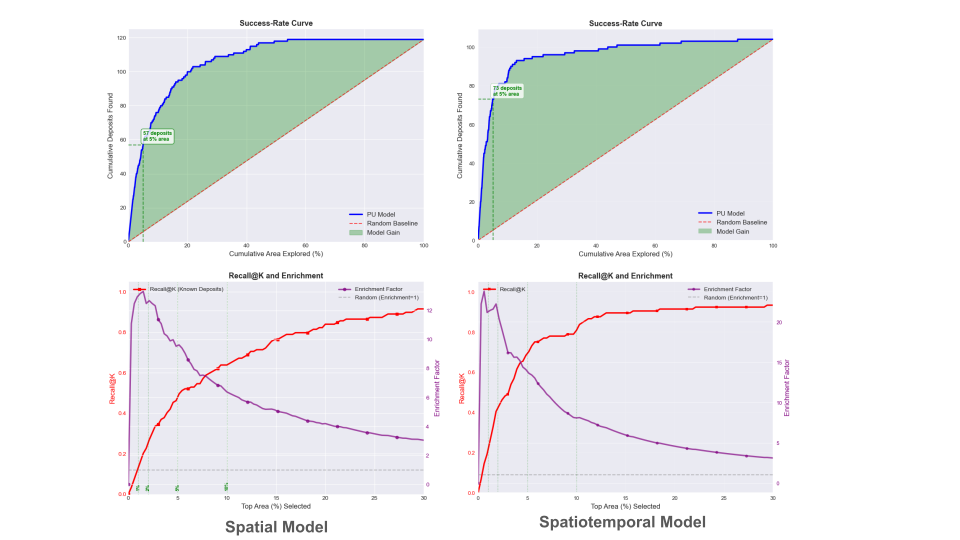
Figure 2 — Model evaluation using success-rate curves and recall–enrichment metrics. Top panels show success-rate curves illustrating the cumulative proportion of known deposits captured as a function of explored area relative to a random baseline. Bottom panels show Recall@K and enrichment factor metrics for highest-ranked prospective areas. The spatiotemporal model demonstrates significantly improved early discovery efficiency, capturing a larger proportion of deposits within a smaller exploration footprint.
Spatial Model: Strong Baseline, Fundamental Ceiling
The spatial model is genuinely impressive. AUC-ROC of 0.926 means it ranks deposits well above background almost everywhere. But it hits a ceiling — and understanding why that ceiling exists is what motivates Part 2.
What the Spatial Model Gets Right
Feature importance analysis reveals the model has learned something geologically coherent. The dominant predictors are structural:
The top individual predictor is GeophysicsGravity_x_grad_std (importance 0.184) — the spatial variability of the gravity gradient.
This makes perfect geological sense: porphyry deposits cluster near structural boundaries where magma ascent paths concentrate,
and these boundaries appear as sharp gravity gradient changes. The model has, without being told, learned to look for structural complexity.
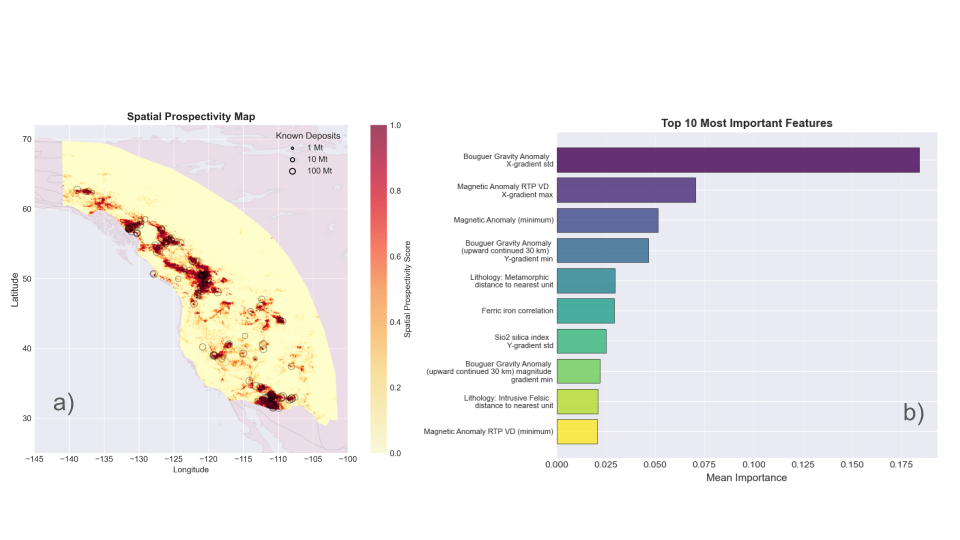
Figure 3 — Spatial prospectivity modelling and feature importance. (a) Spatial prospectivity map generated from present-day geophysical, geological, and geochemical predictors — warmer colours represent higher scores, circles denote known copper deposits scaled by size. (b) Mean feature importance from the ML model, highlighting dominant predictors: Bouguer gravity gradients, magnetic anomalies, lithological proximity, and geochemical indices.
The Fundamental Limit of Static Snapshots
The spatial model can answer: "Does this location look permissive right now?" It cannot answer: "Did this location ever experience the right tectonic conditions to generate a giant porphyry system?"
These are profoundly different questions. The Cordillera was not always the Cordillera. Fifty million years ago, plate geometries were different, convergence rates were different, and most importantly, the composition of material being subducted was different. The deposits that formed then are now exposed at the surface — but the spatial model only sees today's rock, not the ancient process that made them.
The Ceiling
Even with perfect feature engineering, a spatial-only model cannot exceed a fundamental performance ceiling because static spatial patterns are ambiguous. Two locations with identical present-day geology may have had completely different tectonic histories — one fertile, one barren. Without access to that history, the model cannot separate them. This is what Part 2 solves.
The Missing Dimension: Time
Part 1 built a powerful spatial model. Part 2 asks a more fundamental question: what if the very concept of "spatial prospectivity" is incomplete? What if the most important controls on deposit formation are not visible in today's geological map at all?
Earth's Crust is Not Static
Over geological time, the crust is in constant motion. Plates converge, collide, and break apart. Subduction zones migrate. Crustal thickness evolves. The composition of material being subducted changes as ocean basins open and close. These processes operate on timescales of tens of millions of years — and they control where and when porphyry copper systems form.
Consider the North American Cordillera. The belt of porphyry copper deposits from Alaska to Mexico did not form uniformly through time. They cluster in specific metallogenic episodes — brief windows, typically a few million years, when conditions aligned perfectly. Between those windows, subduction continued but produced no major copper deposits.
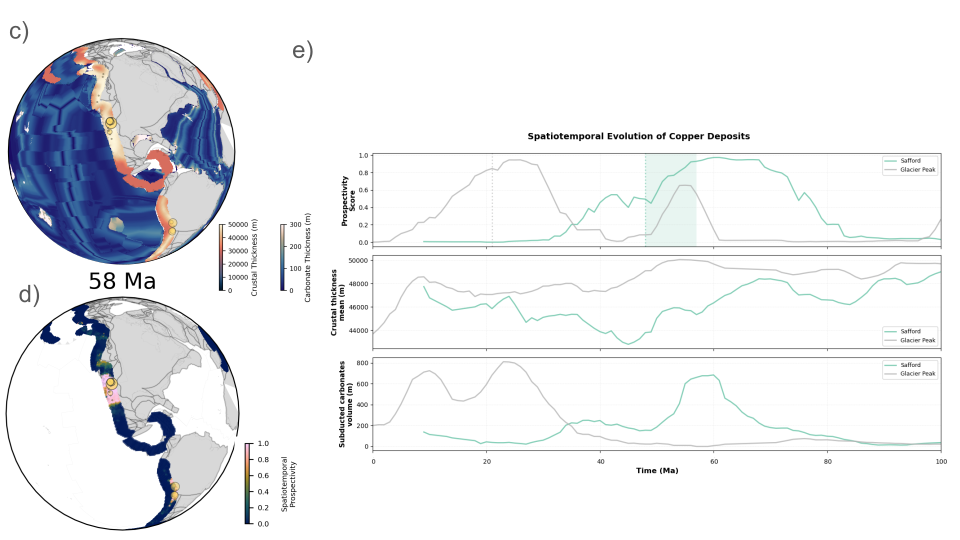
Figure 4 (c–e) — Plate-tectonic reconstructions at ~58 Ma illustrating the subduction configuration at the time of Safford porphyry copper formation (c–d), and temporal evolution of predicted prospectivity alongside deep-time predictors for the Safford and Glacier Peak deposits (e). Prospectivity spikes align precisely with pulses in subducted carbonate flux and favourable crustal thickness — demonstrating how temporal variations in subduction dynamics control porphyry formation windows.
The Spatial Paradox
Here is the paradox that spatial models cannot resolve: two locations at the same latitude on the same arc can look geologically similar today — same rock types, same gravity anomaly, same structural setting — yet one hosts a giant porphyry and the other does not.
The difference is temporal. One location experienced a critical tectonic window — elevated carbonate subduction, favourable convergence geometry, sufficient crustal thickness — at the right time in its history. The other did not. The spatial snapshot captures neither the window nor its absence. This is the fundamental limitation that deep-time modelling overcomes.
Key Insight: Same Location, Different Time
The same geographical location can be simultaneously: Spatially permissive (favourable present-day geology) and Temporally barren (no critical tectonic window in its history). Or: spatially unremarkable (eroded, covered) yet temporally fertile (a major tectonic window occurred). Only a spatiotemporal model can see both.
Geological Controls Through Time
To understand what the temporal model is learning, we need to understand the deep-time variables that control porphyry copper fertility. Each of these variables is a proxy for a specific physical process in the subduction system.
Crustal Thickness
Physical role: Thicker crust provides more storage volume for differentiating magmas. As magma stalls in the lower crust, it undergoes garnet-bearing fractional crystallisation — a process that concentrates copper and other chalcophile elements in the residual melt. Without sufficient thickness, magmas rise too fast and release their volatiles before enough metal accumulates.
Model importance: Crustal thickness is the dominant predictor in the temporal model, accounting for 56.9% of feature importance — more than all other variable groups combined. This validates a core hypothesis of porphyry metallogenic theory.
Subducted Carbonate Flux
Physical role: Carbonate (CaCO₃, MgCO₃) is carried into subduction zones by sediments and altered oceanic crust. When subducted, it releases CO₂ into the mantle wedge. Because carbon in carbonate is in its most oxidised state (+4), this injection raises the oxygen fugacity (fO₂) of the mantle and the magmas it generates. Higher fO₂ changes how copper behaves — see Section 10.
Model importance: carbonate_thickness has individual importance of 0.103 — the second most important deep-time predictor.
Convergence Rate and Geometry
Physical role: The rate at which plates converge controls the flux of material into the subduction channel — and therefore the flux of volatiles and metals into the mantle wedge. Convergence obliquity (the angle between the plate motion vector and the trench) matters too: near-orthogonal convergence creates more efficient subduction and more focused fluid channels. High trench-parallel velocity ("sideways" plate motion) may reduce the efficiency of volatile transfer.
Slab Geometry: Dip, Flux, and Arc-Trench Distance
Physical role: The geometry of the descending slab determines where in the mantle wedge volatiles are released and where partial melting occurs. Shallower slab dip moves the melt generation zone further from the trench and deeper into the overriding plate — potentially under thicker crust. Slab flux controls how much material enters per unit time. Arc-trench distance reflects the geometry of the entire subduction system.
Key Insight: Proxies for Invisible Processes
None of these deep-time variables directly measures magmatic redox state, volatile flux, or metal content — those cannot be directly reconstructed from plate reconstructions. Instead, they are proxies: measurable quantities that correlate with the underlying physical processes through known geological mechanisms. This is a fundamental principle of geochemical and geodynamic inference — we measure what we can, and reason about what we cannot.
The Carbonate–Redox Engine: How Copper Gets Unlocked
The single most mechanistically important concept in this tutorial. Once you understand the carbonate–redox engine, you understand why transient tectonic windows produce giant copper deposits — and why temporal information is irreplaceable.
As ocean plates converge, carbonate-rich sediments — limestones, chalks, carbonated oceanic crust — are carried into the subduction channel. The volume of incoming carbonate varies through geological time as ocean basins open and close and carbonate-rich shelves develop. Key chemistry: carbon in carbonate (CO₃²⁻) is in its most oxidised state: C⁴⁺.
As the slab descends and heats, carbonates break down and release CO₂ into the overlying mantle wedge. This raises the oxygen fugacity (fO₂) — the thermodynamic potential for oxidising reactions. The mantle wedge becomes significantly more oxidised than it would be with carbonate-poor subduction.
Magmas forming in this oxidised mantle wedge are themselves oxidised. This is the critical redox threshold: under normal (reduced) conditions sulfur prefers the sulfide form (S²⁻); under elevated fO₂ it crosses the redox boundary and shifts to sulfate (SO₄²⁻). This shift has profound consequences for metal behaviour.
Under normal reduced conditions, chalcophile metals like copper partition into dense residual sulfide phases in the lower crust — "sulfide sponges" that trap copper before it can rise. Under elevated fO₂ these sulfides destabilise and dissolve back into the melt, releasing enormous copper inventories into metal-charged, volatile-rich magmas.
Copper-rich, volatile-saturated magmas rise through the crust and exsolve a hydrothermal fluid that precipitates copper in a cylindrical alteration shell — a porphyry copper deposit. Giant scale requires the entire chain operating at maximum efficiency simultaneously: high carbonate flux, sufficient crustal thickness for differentiation, and the right structural architecture for focusing fluid flow.
Key Insight: The Engine is Temporal, Not Spatial
The carbonate–redox engine is a transient phenomenon. Carbonate-rich sediments enter the subduction zone only when carbonate platforms develop on the incoming plate — a process controlled by ocean basin history and palaeoclimate. The window when carbonate flux is elevated may last only a few million years. Outside that window, even a structurally ideal arc produces no giant porphyries. This is why time is not an optional add-on to prospectivity modelling — it is the mechanism itself.
Temporal Feature Engineering: Building 4D Earth Trajectories
The temporal model requires a fundamentally different kind of feature: not a snapshot of today's crust, but a time-series of tectonic evolution at each location. This is 4D Earth modelling.
Trajectory Reconstruction
For each known porphyry deposit location, we ask: "Where was this point on the plate 10, 20, 50, 100 million years ago, and what was the subduction system doing at those times?"
Using plate kinematic models (global reconstructions of plate motions through time), each deposit is "unwound" back through geological time — tracking its position on the overriding plate as the subduction system evolved. At each time step (say, every 1 Ma), the geodynamic state at the reconstructed position is sampled from time-resolved grids.
Figure 11.1 — Conceptual temporal trajectory for the Safford deposit (~48 Ma). Crustal thickness, carbonate flux, and predicted prospectivity are tracked through time at the deposit's reconstructed position. Prospectivity peaks align with elevated carbonate flux and favourable crustal thickness — not at random times in the subduction history.
What the Trajectory Contains
After trajectory reconstruction, each deposit location has approximately 50 deep-time variables measured at multiple time steps. These are then aggregated into predictors such as:
- Maximum carbonate flux ever experienced — did this location ever see an intense carbonate pulse?
- Mean crustal thickness at peak prospectivity — how thick was the crust when conditions were most favourable?
- Convergence geometry during the mineral-fertile window — was convergence orthogonal or oblique?
- Duration of favourable conditions — brief windows vs sustained fertility.
This is not normal ML feature engineering. It is building a geodynamic biography of each location through deep time — and that biography turns out to be far more predictive than any snapshot of today's surface.
Key Insight: 4D Is Not Just "Adding Time"
Adding temporal features is not the same as adding an extra column to a spreadsheet. It requires plate kinematic models to reconstruct past positions, time-resolved geodynamic grids to sample at each time step, and geological reasoning to identify which windows in the trajectory are the most predictive. This is a genuinely different type of Earth-system modelling.
Stream B: The Temporal Model
With temporal features constructed, Stream B applies the same PU + XGBoost framework as Stream A, but asking a different question: not "does this place look right?" but "did this place ever experience the right conditions?"
Same Framework, Different Question
Stream B uses identical ML architecture to Stream A: PU Bagging with XGBoost, tonnage-weighted training, RandomizedSearchCV hyperparameter optimisation with 5-fold CV. The only difference is the input feature matrix — instead of present-day geophysics and lithology, it ingests the reconstructed time-series of deep-time variables.
Hyperparameter optimisation for Stream B used 50 random search iterations (vs 100 for Stream A), reflecting the smaller feature dimensionality. Best CV AUC-ROC: 0.9579 — slightly higher than Stream A's 0.9414, suggesting that deep-time signals have slightly better intrinsic discriminating power than static spatial ones.
What the Temporal Model Outputs
For each grid cell in the study area, Stream B outputs a temporal favorability score T(x,y): the probability that this location's tectonic history includes a critical fertility window for porphyry copper formation. This score is high where the deep-time record shows elevated carbonate flux, favourable crustal thickness, and near-orthogonal convergence at the same geological time. It is low where the tectonic history shows none of these aligned conditions.
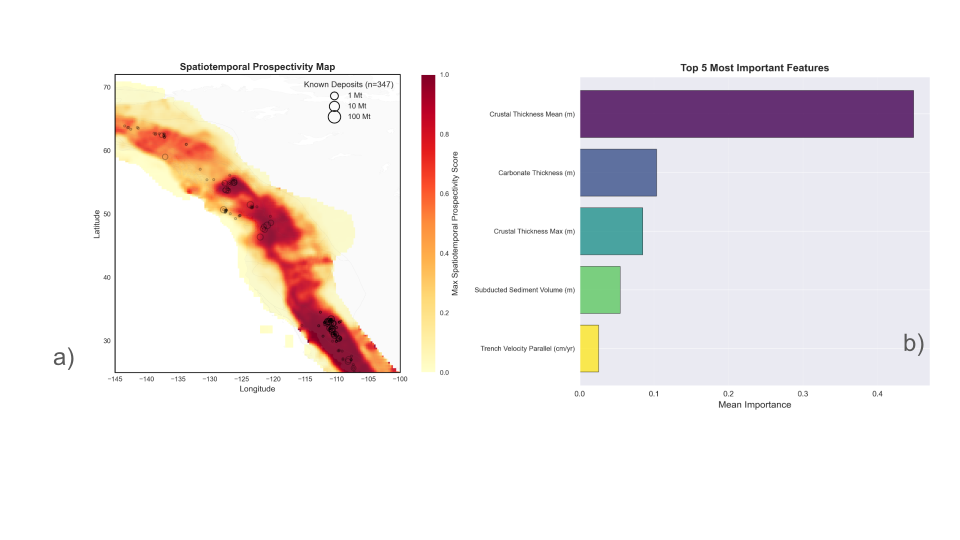
Figure 4 (a–b) — Spatiotemporal prospectivity modelling. (a) Maximum spatiotemporal prospectivity map integrating plate-tectonic reconstructions and deep-time predictors through time — known deposits shown for comparison. (b) Relative importance of top deep-time predictors: crustal thickness dominates, followed by subducted carbonate flux, convergence rate, precipitation, and trench proximity.
Why Spatiotemporal Works Better: The WHERE + WHEN Logic
The intuition for why adding time improves discovery efficiency is simple — but its implications are profound.
Spatial = WHERE. Temporal = WHEN. Together = TRUE Prospectivity.
Think of mineral exploration as solving a conjunction problem:
- The spatial model asks: "Is the present-day geology the right type of crust for a porphyry deposit?" It finds where deposits can exist.
- The temporal model asks: "Did this location's tectonic history include a fertile window?" It finds when conditions were right.
- Both conditions are necessary. Neither is sufficient alone.
A location might pass the spatial test (good rock types, right structural setting) but fail the temporal test (the carbonate pulse happened 200 km away and 30 million years before this location was in the arc). That location will have high spatial prospectivity but low temporal favorability — and no deposit.
Conversely, a location might have experienced a perfect tectonic window but is now deeply eroded, glaciated, or covered by younger sediments. Its spatial signature may be weak, but its temporal signature remains strong. The spatiotemporal model finds it; the spatial model misses it.
Key Insight: False Positives Eliminated
Many high-scoring spatial targets are false positives: the geology looks right, but no deposit ever formed because the temporal conditions were never met. The temporal model eliminates these by filtering out locations with unfavourable tectonic histories. This is why the combined model achieves dramatically higher Recall@K at top 1-5% fractions — it has fewer false positives contaminating the high-priority target list.
Hyperdimensional Integration: Fusing Space and Time
The final model is built by combining Stream A and Stream B into a single hyperdimensional prospectivity surface. The fusion operator is deceptively simple — and deeply principled.
The Integration Formula
- S(x,y) = spatial prospectivity from Stream A (present-day geology)
- T(x,y) = temporal favorability from Stream B (time-integrated deep-time history)
- H(x,y) = hyperdimensional prospectivity (final exploration score)
Both S and T are probability-like scores between 0 and 1. The final score H is their product — also between 0 and 1, but only high if both inputs are high simultaneously.
Score Distribution and Target Prioritisation
The integrated field spans nearly the full unit interval, but the upper tail is sharply compressed:
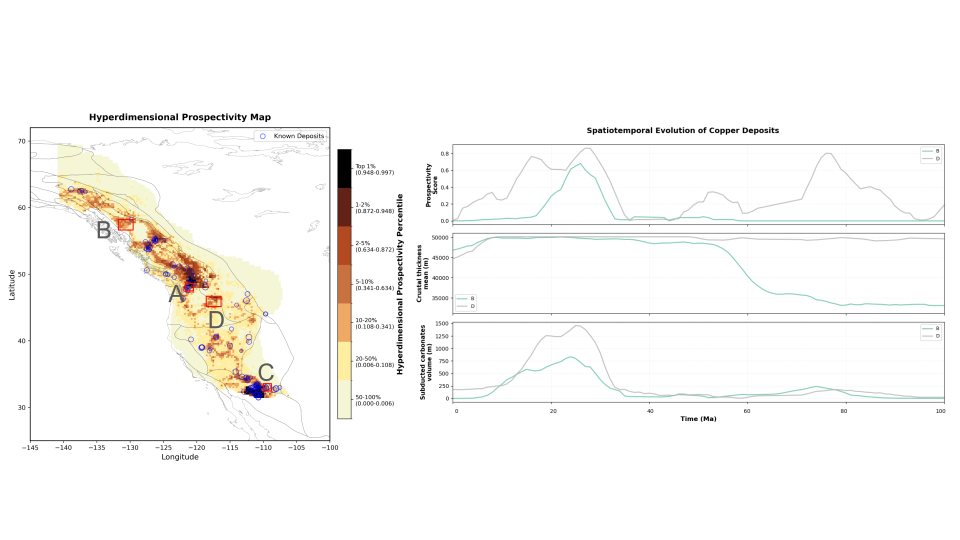
Figure 5 — Hyperdimensional prospectivity map combining present-day spatial datasets with deep-time tectonic predictors, shown as percentile values highlighting high-priority exploration targets. Known porphyry deposits are overlaid. (A, C) Giant deposits Glacier Peak (1,710 Mt) and Safford (7,260 Mt). (B, D) High-score locations within previously underexplored regions exhibiting tectonic conditions comparable to major porphyry systems — indicating high potential for future discovery.
Why Multiplicative? The AND Gate of Geology
The choice of multiplication over addition is not arbitrary. It encodes a fundamental geological principle — and understanding it illuminates why the hyperdimensional model is much more than the sum of its parts.
Addition vs Multiplication: What the Difference Means
Addition (OR logic): S + T
A location scores high if either the spatial conditions are good or the temporal conditions are good. This would produce many false positives: geologically permissive locations with barren tectonic histories, and vice versa.
Multiplication (AND logic): S × T
A location scores high only if both the spatial conditions are good and the temporal conditions are good. A single low score in either dimension suppresses the final result to near zero.
Mathematically, if S = 0.9 (very good spatial permissivity) but T = 0.1 (barren tectonic history): H = 0.09. The location drops to the bottom third of the ranked list. If S = 0.7 and T = 0.8: H = 0.56. A genuinely high-confidence target.
This is geologically correct. Porphyry copper formation requires the convergence of multiple independent conditions. The ore system does not form if spatial permissivity is present but tectonic fertility is absent — or vice versa. The AND gate encodes that reality directly.
Why This Removes False Positives
The spatial model has many high-scoring cells that are geological look-alikes of deposit regions but have no deposit. Why? Because they never experienced a carbonate-rich subduction pulse. These cells have high S but low T. Multiplication drives their H score near zero, removing them from the target list. This is why the enrichment factor at top 1% jumps from 13× (spatial alone) to 21× (hyperdimensional) — the false positive suppression is dramatic.
Key Insight: Conjunctive Permissivity
The term used in the paper is "conjunctive permissivity": high prospectivity requires all conditions to be simultaneously satisfied, not just some of them. Multiplication enforces conjunctive logic. This is not a mathematical trick — it is a direct translation of the physical reality of ore formation into a mathematical operator.
Results: What the Numbers Tell Us
The final results of the hyperdimensional model demonstrate a lesson that is critical for applied AI in geoscience: a small improvement in global metrics can correspond to a massive improvement in practical performance.
The Paradox of Modest AUC, Dramatic Recall
Compare the two models:
| Metric | Spatial Only | Spatiotemporal | Interpretation |
|---|---|---|---|
| AUC-ROC | 0.926 | 0.947 | Small improvement in global ranking quality |
| AUC-PR | 0.643 | 0.645 | Virtually identical average precision |
| Recall@1% | 13.5% | 21.2% | +57% more deposits found in top 1% of area |
| Recall@5% | 47.9% | 70.2% | +46% improvement in top 5% of area |
| Enrichment@1% | 13.5× | 21.1× | 56% better deposit density in top targets |
| Median deposit rank | 5.19 percentile | 3.2 percentile | Deposits concentrated in smaller search space |
The AUC-ROC improves by only +0.021 — a modest change that, in many ML benchmarks, would be considered marginal. But the Recall@5% improves from 47.9% to 70.2% — a 46% gain in deposit discovery rate within the priority exploration window.
Why the disconnect? AUC-ROC is a global metric averaged across all score thresholds. Deep-time information primarily improves ranking at the top of the list — the very small fraction of high-priority targets that drive early-stage exploration decisions. It does not dramatically change how well the model separates deposits from background at the median threshold. But exploration does not happen at the median threshold — it happens at the top 5%.
Forensic Case Studies: What the Tectonic Window Looks Like
Two deposits were used as forensic case studies to visualise what a tectonic fertility window looks like in temporal space:
Safford (7,260 Mt Cu, ~48 Ma)
Temporal trajectory shows a pronounced prospectivity spike centred at ~48–57 Ma, coinciding with elevated carbonate subduction, convergence geometry shifting toward orthogonal, and favourable crustal thickness. Outside this window (before and after), prospectivity is low despite similar structural setting.
Glacier Peak (1,710 Mt Cu, ~21 Ma)
Shows a prospectivity peak at ~21 Ma aligned with a carbonate flux pulse. The temporal signature is cleaner and shorter than Safford, consistent with a briefer but intense tectonic window.
Figure 4 (c–e) — Temporal evolution of predicted prospectivity and deep-time predictors for Safford and Glacier Peak. Time-series plots (e) illustrate how predicted prospectivity tracks crustal thickness, subducted carbonate flux, and convergence rate through geological time. Prospectivity spikes at the known mineralisation ages (~48 Ma for Safford, ~21 Ma for Glacier Peak) — directly confirming the carbonate–redox engine as a transient tectonic window that the AI has independently rediscovered from data.
What AI Rediscovered: Physics in the Feature Importance
One of the most satisfying outcomes of this study is what the model independently learned from data — and how closely it aligns with the physical theory of porphyry copper formation. The AI did not just predict; it rediscovered geology.
Stream B Feature Importance Hierarchy
Why This Validates the Physical Model
Crustal thickness as the dominant predictor is exactly what porphyry metallogenic theory predicts. Thicker crust is required for garnet-bearing fractionation of magmas — the differentiation process that concentrates copper. The model learned this without being told. It found it in the data.
Carbonate flux as the second most important group (18.3%) validates the carbonate–redox engine hypothesis directly. The model found that knowing how much carbonate was subducted is more predictive than any single kinematic or structural variable — a result that directly supports the geochemical mechanism proposed for giant porphyry formation.
Convergence geometry (12.1%) validates the role of orthogonal convergence in focusing fluid flux and concentrating arc magmatism.
Key Insight: AI as Physical Discovery Engine
This is the highest form of ML application in geoscience: the model does not just predict — it independently recovers physical mechanisms from data. When a machine learning model, trained purely on data correlations, produces feature importance rankings that match decades of geological theory about ore formation — that is independent quantitative validation of the theory. It also suggests that the model is not overfitting: it has found the real signal, not noise.
Final Takeaway: A New Way of Thinking About Ore Formation
This tutorial has taught you two complete AI workflows for mineral prospectivity. But more importantly, it has taught you a new way of framing the geological question. The shift in thinking is from spatial to temporal, from where to when.
"Where are the favourable rocks?"
Find the right geology: the right rock types, the right structures, the right alteration footprints. Map what exists today and infer where deposits might hide.
Limitation: treats deposits as timeless features of a static map.
"When did the system become fertile?"
Find the right tectonic window: the right combination of carbonate flux, crustal thickness, and convergence geometry at the right time in the deposit's tectonic history.
Breakthrough: treats deposits as outcomes of transient geodynamic events.
Three Principles for AI-Driven Mineral Prospectivity
A well-designed feature that encodes geological context will outperform any sophisticated algorithm applied to raw pixels. Invest in understanding what physics each feature captures before writing any ML code.
Treating unlabeled data as negatives is not a technical shortcut — it is a fundamental scientific error. Always apply PU learning when the absence of a label does not equal confirmed absence of the target.
A model that achieves 0.95 AUC-ROC but poor Recall@K is useless for early-stage exploration. Always evaluate with the metric that reflects how the model output will actually be used to make decisions.
The Road Ahead
The hyperdimensional framework developed for the North American Cordillera is not region-specific. The carbonate–redox engine operates wherever convergent margins develop carbonate-rich subduction. The Tethyan belt, the circum-Pacific arcs, the Andean margin — all can be evaluated through the same deep-time lens.
Future work will couple this statistical framework with thermo-mechanical subduction models, more granular geochemical constraints on slab composition, and time-resolved magmatic flux data. But the fundamental insight stands: the next generation of giant porphyry copper discoveries will be found not by better mapping of today's surface, but by better understanding of the Earth's tectonic past.
The Central Thesis
Major porphyry copper systems are preferentially generated during transient, multi-factor tectonic windows that combine carbonate-rich slab input with favourable convergence geometry and lithospheric state. Spatial-only models cannot adequately encode this transient history. Hyperdimensional integration recovers this missing information and materially improves early-stage discovery efficiency — not by a few percent, but by a factor of two or more at the exploration decision horizon.